
Beyond the Iron Curtain
Rachel and I knew we wanted to visit this museum. Andrea, our tour guide, told us it was the one thing she would do if she had to choose. She was right!
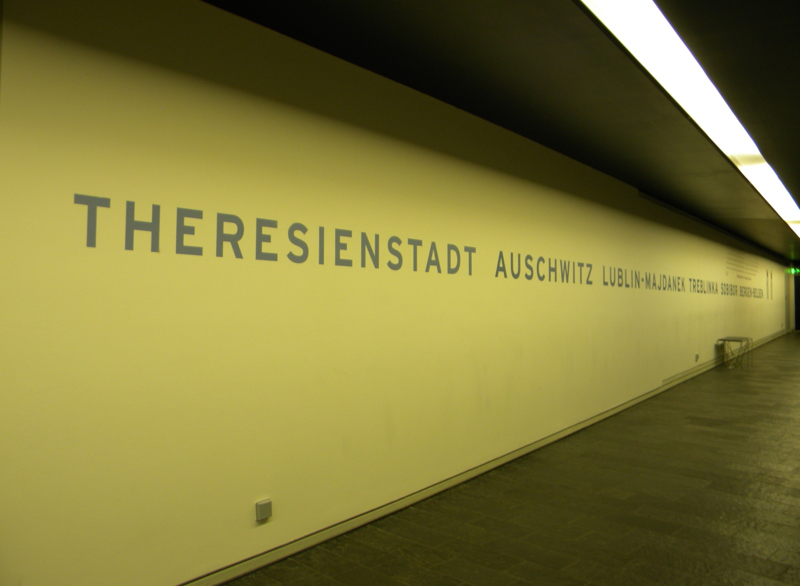
Constructed by architect Daniel Libeskind, the Jewish Museum of Berlin is intended to allow the visitor to interpret the experiences of the Jew for himself. I do not mean the actual facts of what happened during the Holocaust...those are not questioned. What is left for the visitor to experience are the feelings that Jews may have experienced. Even when this information was conveyed to me, I did not understand how that could happen in a museum. Now I know!
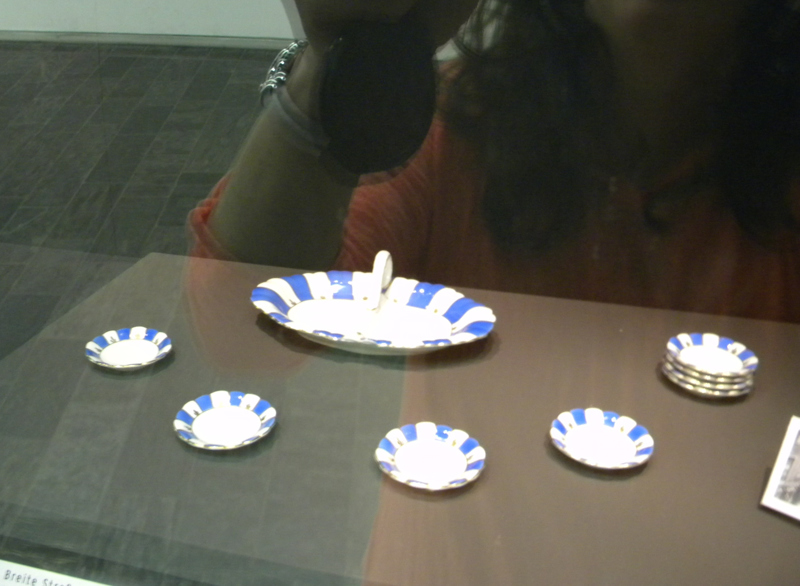
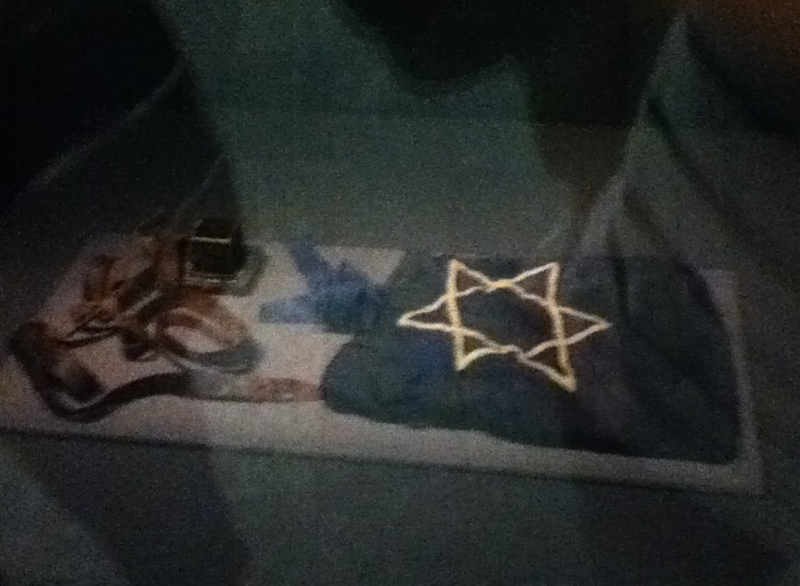
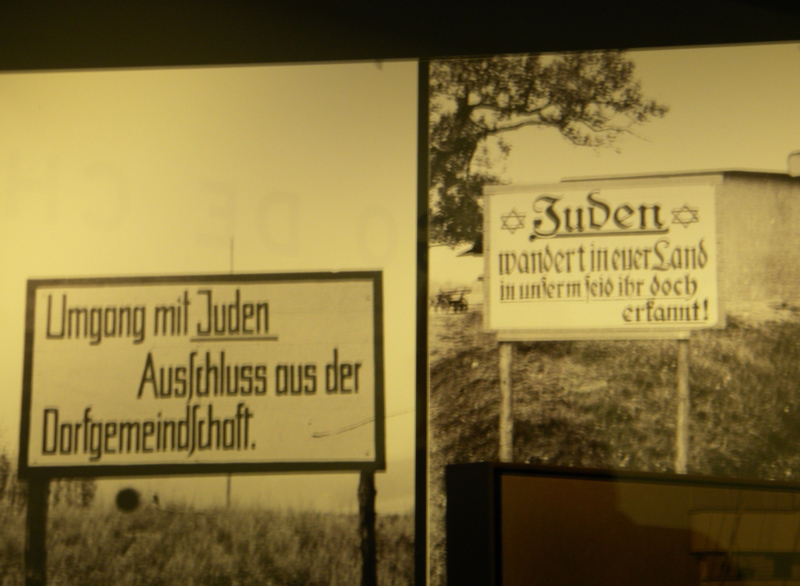
This museum presents a small number of personal stories and objects and artifacts without interpretation or manipulation. It also use space to communicate with the visitor....crazy, I know. One display that really affected me consisted of signs that were found on the edge of different communities in Europe...mostly Germany. The basic message of those signs was..."Jews not welcome." Wow...I wonder how it felt to read those for the first time....or the last....
The first type of space Libeskind uses he calls "voids"- large, empty, sterile spaces. The voids really do give a feeling of what the world lost when hundreds of thousands of Jews-and others- were murdered during the Holocaust. I felt like I

lorriefe
8 chapters
15 Apr 2020
Jewish Museum
Berlin
Rachel and I knew we wanted to visit this museum. Andrea, our tour guide, told us it was the one thing she would do if she had to choose. She was right!
Constructed by architect Daniel Libeskind, the Jewish Museum of Berlin is intended to allow the visitor to interpret the experiences of the Jew for himself. I do not mean the actual facts of what happened during the Holocaust...those are not questioned. What is left for the visitor to experience are the feelings that Jews may have experienced. Even when this information was conveyed to me, I did not understand how that could happen in a museum. Now I know!
This museum presents a small number of personal stories and objects and artifacts without interpretation or manipulation. It also use space to communicate with the visitor....crazy, I know. One display that really affected me consisted of signs that were found on the edge of different communities in Europe...mostly Germany. The basic message of those signs was..."Jews not welcome." Wow...I wonder how it felt to read those for the first time....or the last....
The first type of space Libeskind uses he calls "voids"- large, empty, sterile spaces. The voids really do give a feeling of what the world lost when hundreds of thousands of Jews-and others- were murdered during the Holocaust. I felt like I
wanted to find something in these spaces...like something was missing...like the creators of the museum forgot something.
The second space I experienced was the Holocaust Tower. I was very uncomfortable in this space. It was extremely sterile, dark, overwhelmingly large, and empty. The door to the tower slammed very loudly and disturbingly. There was one stream of light from the top. Two of the corners of the tower were extremely acute angles and there were two people in the room when Rachel and I entered....one in each of those acute angles opposite one another. They just stood there like statues....as far apart as they could be in the space. I am not sure I have ever wanted to get out of a room as badly as I wanted out of that one. Rachel, of course, wanted to experience it.....I left her in there and then felt like I needed to go back in so she was not alone. Overwhelmingly fearful is an appropriate description for my experience there.
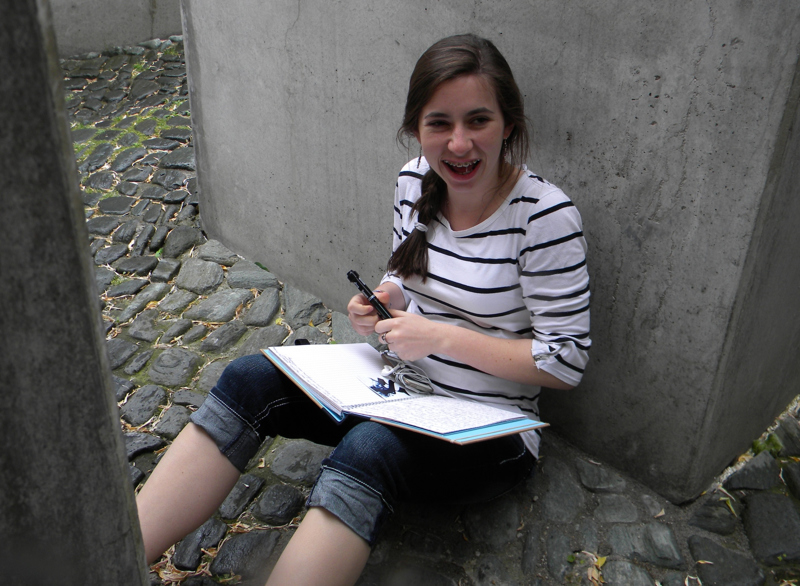
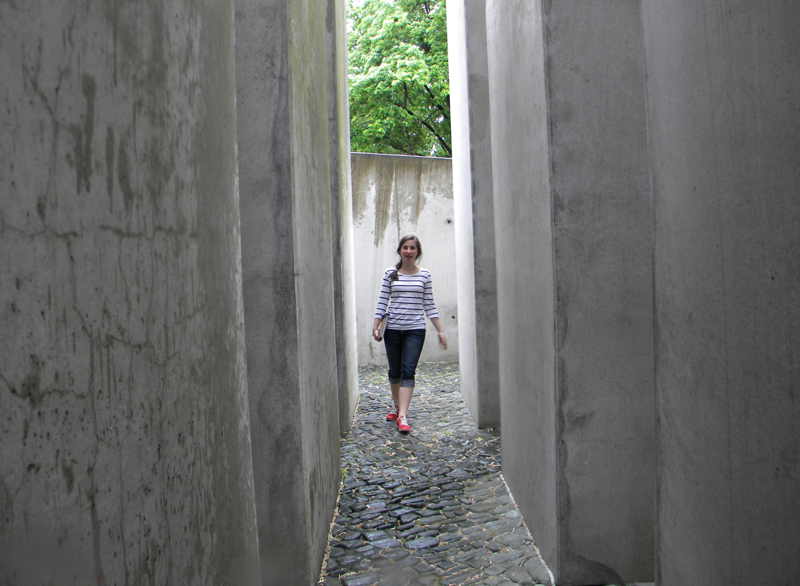
The next space was the Exile Garden. Wow....this space was outside. The ground was constructed of cobblestone and was slanted. Concrete pillars were orderly placed in rows (like the Jewish memorial) but were slanting at different angles. Trees grew and created a canopy above the pillars. Rachel and I both felt disoriented and unbalanced as we tried to maneuver that space. Rachel finally sat down and began to journal. The whole point of the space was to represent what Jews may have felt like in Exile....yes, their lives had been spared and they had new opportunities...but they were in foreign lands, possibly alone, and trying to gain stability was probably difficult and confusing at best.
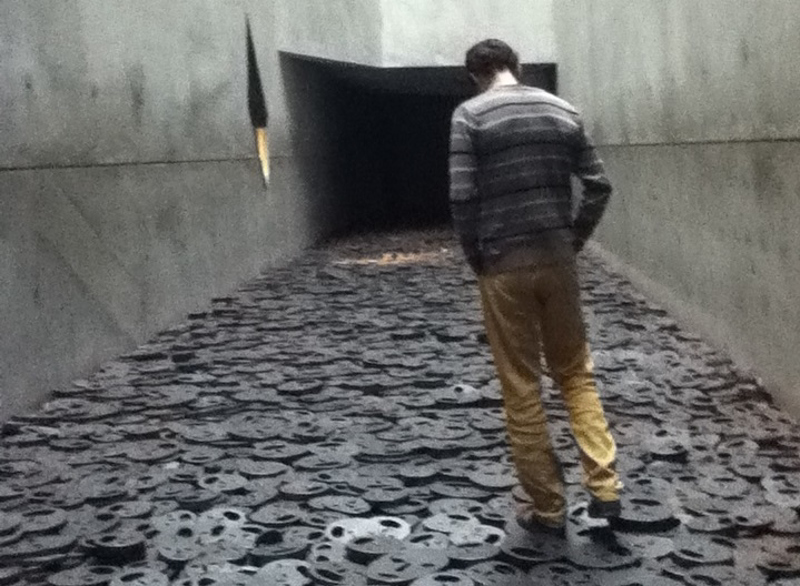
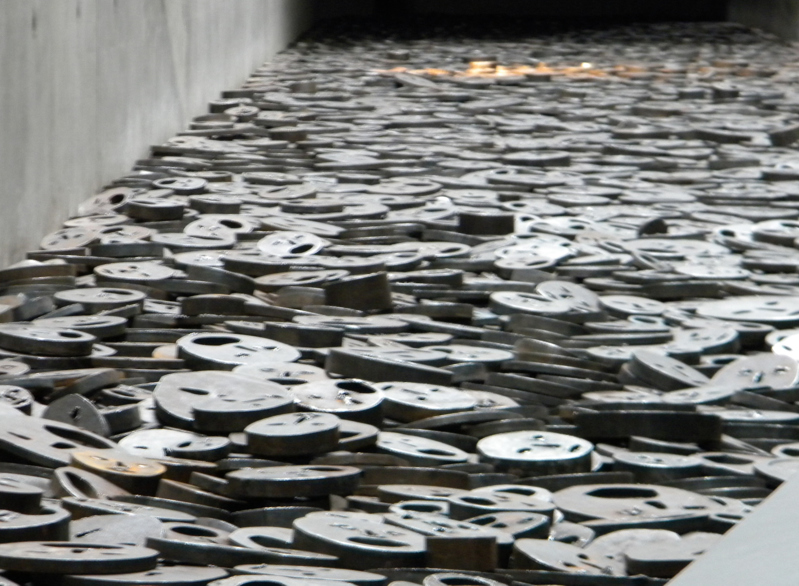
The most interesting experience for me was another tall, expansive space where the floor was covered with metallic faces. The faces were carved of differing shades of copper and gray. They were different sizes and shapes, and they were all thrown on the floor on top of each other. They could be touched, moved, walked-on....and they were loud. The same young man who had been in the corner of that tower was now slowly, methodically, intentionally walking on...and among...the faces. I knew immediately that there was NO WAY I could walk on those faces. I would have felt as if I was walking on those people...trampling them all over again...disrespectful and dishonoring. However, this young man seemed to have a need to be among them....to identify with them. Interestingly, Rachel wanted to walk out, but could not do it either.
Finally, in another part of this museum there was a video about Jewish diaspora throughout history. Diaspora is the word used to describe a group of people from the same culture, race, or nationality that lives in communities that are not their ancestral home, yet they maintain their language, culture, traditions, identity, and
religion. Different cultural diaspora are all over the world...more later.


